
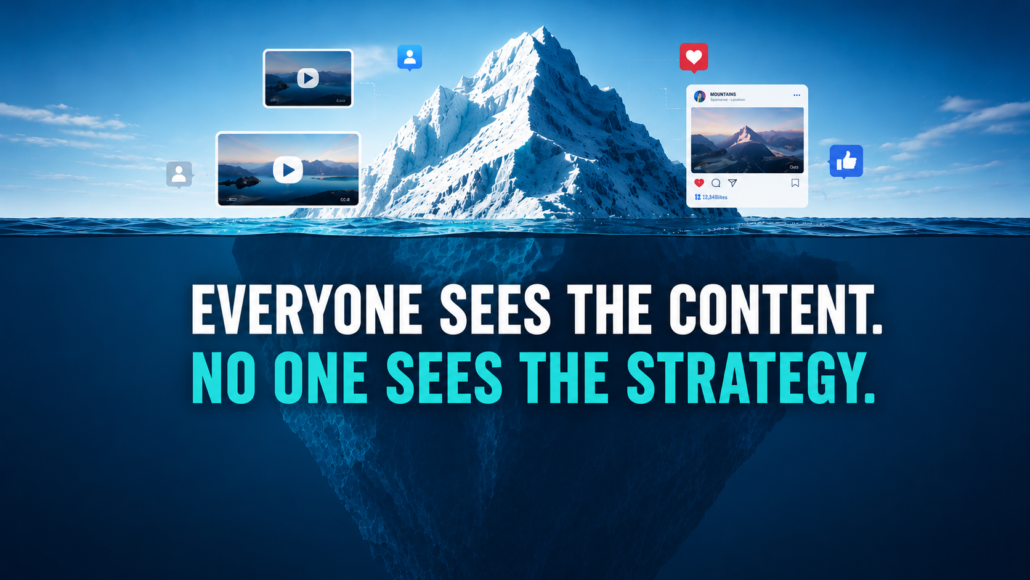
The democratization of marketing and the erosion of expertise
There is something happening to marketing and communications that I think people inside the industry feel very deeply, even if they struggle to articulate it clearly. The democratization of digital tools, social media, accessible design platforms like Canva, automated ad systems, and now AI-generated content has created the impression that marketing is something almost anyone can do professionally with little to no real formation behind it. Today, someone can open ChatGPT and ask for a marketing strategy, a communication plan, email campaigns, captions, ad copy, audience personas, and content calendars within seconds. Someone else can open Canva and create visuals that look polished enough to pass as professional work. On the surface, it feels empowering, efficient, and modern. In many ways, it genuinely is.
That is why I both agree and disagree when people say that you do not need school for marketing, communications, or PR. I agree because knowledge itself has become more accessible than ever before. Most of the theories taught in communications and marketing programs are not secret. They already exist in books, archives, case studies, academic research, documentaries, and now countless online resources. A disciplined and intellectually curious person can absolutely self-educate. The theories of persuasion, audience behavior, media ecosystems, crisis communication, semiotics, framing, branding, public opinion, social psychology, and consumer behavior are all available to anyone willing to seriously study them.
What I disagree with is the growing belief that because tools became accessible, the foundations no longer matter. That is where I think the profession started losing something important. Most marketers I encounter, including at executive and C-suite levels, did not originally study marketing or communications. Many studied completely different fields and later pivoted into branding, communications, content, or marketing roles because their careers naturally evolved in that direction. Others started in small companies where people wore multiple hats, touched many departments, experimented, learned on the job, and gradually grew into leadership positions. There is absolutely nothing wrong with that. In fact, the ability to pivot is one of the strengths of modern professional life. Knowledge is not fixed. Human beings evolve, adapt, and reinvent themselves constantly.
But what I often notice is that when people never return to study the deeper foundations of strategic communication, it eventually translates into the way they approach the work. They become excellent at execution, excellent at producing deliverables, excellent at creating things that look attractive, trendy, engaging, or visually impressive. But the work itself often remains surface-level because the intellectual architecture behind communication was never fully built.
Today, photographers suddenly present themselves as social media marketers because they know how to produce aesthetically pleasing visuals. Web designers become branding experts because they can create visually modern websites and graphics. People who know how to use scheduling tools, templates, and AI prompts increasingly position themselves as strategists. The lines between technical production and actual communication strategy have become completely blurred.
What makes this especially interesting is that these distinctions existed for a reason. Traditional communications and marketing disciplines evolved separately because they required different forms of expertise and different modes of thinking. The graphic designer was not the web developer. The web developer was not the communications strategist. The social media manager was not the PR specialist. The marketing strategist was not simply the person making graphics or writing captions. These roles complemented each other because each required depth in a specific discipline.
Organizations themselves have also contributed to this shift. In pursuit of efficiency, many companies have consolidated roles that were once distinct disciplines. Today, employers increasingly expect one person to handle branding, strategy, social media, graphic design, video editing, copywriting, analytics, PR, SEO, advertising, community management, photography, email campaigns, customer insights, and web design all at once. While this approach may reduce costs and increase agility, it also encourages a view of marketing as a collection of tasks rather than a discipline grounded in research, analysis, and human understanding. As a result, every discipline becomes compressed into quick execution, constant production, and endless content output. The consequence is that depth quietly disappears.
And I think one of the biggest misconceptions created by AI is the idea that marketing is essentially the same thing as content production. People see AI generating social media posts and immediately conclude that entire marketing departments are becoming obsolete. But social media content is only a small fraction of what serious marketing work actually involves.
Marketing is not simply posting. Who is doing the market analysis to identify shifts in behavior, emerging opportunities, competitive gaps, and cultural trends? Who is actually speaking to customers to understand their frustrations, aspirations, emotional triggers, purchasing hesitations, and decision-making processes? Who is studying positioning, pricing, audience segmentation, consumer perception, and long-term brand equity? Who is determining whether a company’s messaging aligns with the reality of the product experience itself? Who is shaping the larger narrative architecture behind the business?
These are not small details. They are the core of the discipline. A company can automate captions all day long and still completely misunderstand its audience. It can produce endless AI-generated content and still fail to understand why people trust one brand over another, why some campaigns create emotional resonance while others disappear instantly, or why certain brands become cultural symbols while others remain interchangeable commodities.
At the same time, it would be inaccurate to suggest that artificial intelligence is limited to content creation alone. Today’s AI systems can generate positioning statements, audience segments, competitive analyses, messaging frameworks, and even complete go-to-market strategies. In many cases, they can do so remarkably well. The question, however, is not whether AI can generate strategic recommendations. The question is who is evaluating those recommendations, validating them against reality, and making the judgment calls that strategy ultimately requires. A strategy document is not strategy. Strategy is the process of making choices, accepting trade-offs, and operating under conditions of uncertainty.
That is because communications, PR, and marketing were never fundamentally about tools. They were always about understanding people. At its core, communications is deeply tied to human psychology and social psychology. It is about understanding attention, perception, aspiration, emotion, trust, fear, symbolism, identity, belonging, and behavior. It is about understanding what moves people emotionally, culturally, politically, and socially before you even begin producing content.
The most valuable marketing insights rarely come from software. They come from observing people. They emerge from conversations with customers, from understanding cultural shifts, from recognizing unmet needs, and from identifying the emotional factors that influence decision-making. Technology can help process information and uncover patterns, but it cannot replace the curiosity required to understand why people behave the way they do.
That dimension of the work increasingly feels undervalued in environments obsessed with speed, trends, visibility, and output. Of course anyone can now create a decent-looking visual in Canva. Of course anyone can ask AI to draft an email sequence or generate social media captions. Of course anyone can imitate the external aesthetics of marketing. But there is a difference between producing content and understanding communication.
And I think that is the part many professionals feel is disappearing from the industry. Something about the profession has become flattened. The marketer used to be seen as someone who deeply understood positioning, audience psychology, narrative construction, public perception, and cultural context. Increasingly, the role is being reduced to content production and platform management. The work is becoming faster, cheaper, more automated, more accessible, and in many ways more superficial.
Ironically, I think AI will eventually make the importance of real strategic thinking even more obvious. Once everyone has access to decent execution, execution itself stops being the differentiator. If everyone can generate acceptable captions, acceptable visuals, acceptable emails, and acceptable campaigns within seconds, then the true value shifts back to the quality of thought behind the work. The real differentiator becomes the ability to understand people deeply enough to know what should be said, why it should be said, how it should be framed, who it is speaking to, what emotional reaction it is trying to trigger, and what long-term perception it is trying to build.
Technology has made communication easier than at any point in history. What it has not done is make human beings easier to understand. And as long as organizations depend on human attention, trust, emotion, and decision-making, that understanding will remain the foundation upon which effective marketing is built.







Leave a Reply
Want to join the discussion?Feel free to contribute!