
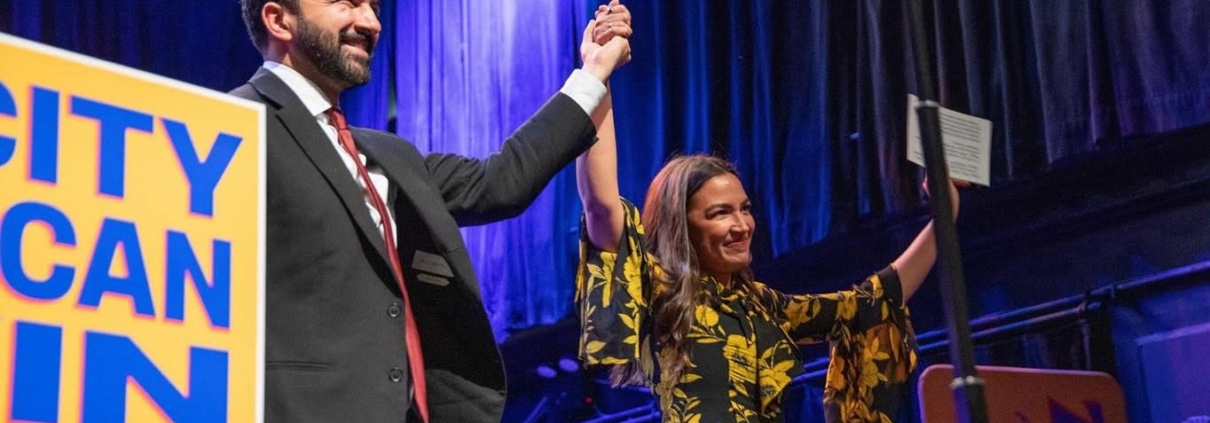
At Terminal 5, Mamdani and Ocasio-Cortez frame NYC Primary as a generational turning point

June 14 — New York

The line stretched down the block long before the doors opened. By early evening, Terminal 5 was packed wall to wall, balconies filled, supporters pressed shoulder to shoulder, and a live band playing from above as chants echoed through the venue. Even outside, the energy was electric.

On the first day of early voting in the June 24 Democratic primary, Assemblymember Zohran Mamdani rallied alongside Rep. Alexandria Ocasio-Cortez in what felt less like a routine campaign stop and more like a moment charged with national implications.

More than 2,500 people filled the West Side concert hall. Community leaders, labor organizers, elected officials and grassroots volunteers were present. The crowd skewed young but was diverse in age, race and borough representation. Many described themselves as working-class New Yorkers struggling with rent, childcare, transit costs and healthcare.

Ocasio-Cortez framed the mayoral race as a broader referendum on the direction of the Democratic Party. Without mincing words, she argued that the choice before voters represents a generational shift. She criticized what she called entrenched leadership and urged supporters not to rank former Gov. Andrew Cuomo on their ballots, positioning the contest as an opportunity to “turn the page” politically.

When Mamdani took the stage, the reception was thunderous. His speech was disciplined but emotionally resonant, centered on affordability, housing, labor rights and what he repeatedly called “the everyday New Yorker.” He leaned into his identity as a Muslim immigrant and democratic socialist, presenting it not as a liability but as evidence of a changing city.

“We are building a movement that money cannot buy,” he said, referencing the influx of outside spending and recent endorsements for Cuomo from major business figures, including former Mayor Michael Bloomberg.

Mamdani urged attendees to volunteer and counter negative messaging in the final stretch before primary day. Speakers throughout the night echoed similar themes, including leaders from the Working Families Party and labor unions, who emphasized coalition politics and working-class solidarity.

What stood out in the room was not just applause lines, but conviction. The atmosphere felt organized, not chaotic. Strategic, not symbolic. There was choreography to the messaging and discipline in the turnout.
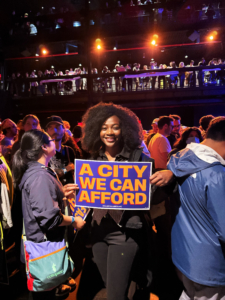
Whether that energy translates into votes remains to be seen. But on June 14, inside Terminal 5, it was clear that this mayoral primary has become more than a local contest. For many in that room, it felt like a statement about the future of power in New York — and perhaps within the Democratic Party itself.


The soulless ChatGPT posts: have we gone too far?

“As technology advances, it reverses the characteristics of every situation again and again. The age of automation is going to be the age of ‘do it yourself.’” Marshall McLuhan

I’ve been thinking about this quote I studied back in undergrad. And the more I think of ChatGPT, the more it resonates.

It’s amazing how powerful AI has become. It saves time, enhances creativity, and every day I’m learning new things it can do: interior design, generating content and images, coding, building business strategies, designing logos, writing scripts, creating outlines, drafting contracts… and the list keeps growing.

But if anyone can produce work instantly, if anyone can write posts and sound like an expert on any topic, then what becomes of the value of human work? Of human thought? What becomes of the importance of a job, or the depth that comes with lived experience?

Has generative AI created conformity and slowly killed human value?

Well you see, McLuhan’s quote reflects his broader idea: technological change isn’t linear, it’s dialectical. He believed that every medium or technology, when pushed far enough, eventually reverses its effects. This is part of his concept called “the tetrad of media effects,” where every technology:

• Enhances something,
• Obsoletes something,
• Retrieves something from the past,
• And reverses into its opposite when overextended.

So yes AI is a gift. But it won’t and shouldn’t prevent us from using our brains. For those who are already thoughtful, it does the things that consume time so we can focus on what really matters, what we’re best at.

What I call a soulless ChatGPT post is easy to spot:

  • It’s grammatically correct.
  • It flows well.
  • It has good ideas.
  • Polished but robotic.
  • No soul. No real voice. Just… bland.
  • All the titles sound the same. The sentence structure is the same.
  • Sounds like a Wikipedia article with plenty of stock emojis: ✨💼📈🔥🙌📊✅

Don’t get me wrong ChatGPT is a powerful tool. But you have to be smart with it. Joanna Maciejewska said:

“I want AI to do my laundry and dishes so that I can do art and writing, not for AI to do my art and writing so that I can do my laundry and dishes.”

Sounds a bit extreme and unrealistic,  but maybe she has a point. We can think about it differently: all of the things that take more time but aren’t central to the originality of your thought or the uniqueness of your perspective or creativity, have ChatGPT do it. Consider those things “the dishes”and now focus on adding the great stuff that makes you a unique voice.

For the love of God, stop giving one vague sentence to ChatGPT and letting it write your whole post.

We can tell can tell it’s a Chat GPT post. It doesn’t bring any value because not only we see the same posts everywhere but we can literally do the same thing you did. Head over to Chat GPT and tell him to “Write a post about X,Y,Z”

Use better prompts. ChatGPT isn’t magic.
Stop being lazy with your prompts. Stop typing lazy stuff like “Write a post about leadership.” One vague sentence will get you a vague post. You want something good? Give context, tone, structure, even examples. Feed it as you would a collaborator, not a vending machine.

Use AI to expand and facilitate your work.
Use it for research, for outlines, to organize your ideas. Use it for things you already care about deeply, have knowledge and perspective on. That way, ChatGPT becomes an addition to the burning fire inside you. That’s how you go from “meh” to “this actually sounds like me.”

Don’t fake what you don’t know.
If you’re clueless about a topic, don’t use AI to bluff your way through. If you want to speak on a subject you’re not familiar with, do your research. Learn the complexities and nuances of the topic. Gain some experience, read the experts, and reflect on it. It’s fine that ChatGPT helped you write it, but it will make a huge difference when the post has a fresh and singular outlook.
Because nothing screams “I copied this” louder than a confident-sounding post that says… nothing new.

And finally: if it doesn’t sound like you, it’s not good.
Copying and pasting the first draft ChatGPT gives you is like serving a frozen meal at a dinner party. The first draft is rarely the best. If the tone, the examples, the vocabulary don’t reflect how you think or express yourself, that’s your sign it’s not ready. Read it out loud. If it feels stiff, generic, or like anyone could’ve written it, rewrite it. Ask it to rephrase. Change the angle. Push back. Good writing is rewriting, even with AI.

Technology is amazing because it allows us to focus on what really matters. But don’t forget: the soul of your work should still come from you.

And by the way, ChatGPT lies a lot. Make sure to always fact-check and don’t embarrass yourself. 😉 If you’re citing studies, quotes, or numbers, verify them. ChatGPT is smart, but it hallucinates confidently.

You don’t need to know the whole plan to begin

So many people stay stuck waiting for clarity. Waiting for a sign, a map, a guarantee. But purpose rarely arrives fully formed. It unfolds in motion — not in stillness.

You don’t need to see the full staircase to take the first step. You need to trust your inner pull. Begin with what you know, with what you feel, with what’s burning quietly inside you. The rest will reveal itself in the doing.

Every guest on Parcours Atypique started somewhere unsure. They launched projects, made decisions, left comfort zones — not because they were certain, but because they were called.

The secret is not knowing. The secret is starting anyway.

🎧 If you need permission to take that next step, listen to someone who already did. You’ll find them on Parcours Atypique.

What makes a voice worth listening To?

In a world where everyone can talk, post, and share instantly, we’re flooded with noise. But not every voice carries weight. Some voices don’t just speak, they resonate. They shift something in us. They stay.

What makes the difference? It’s not always credentials or visibility. Often, it’s courage. Integrity. A hard-earned perspective. A voice worth listening to comes from someone who has lived, questioned, fallen, and risen. Someone who doesn’t perform but reveals.

At Parcours Atypique, we seek out those voices. The ones shaped by fire, silence, and depth. The ones that don’t scream to be heard, but whisper what matters.

🎧 Discover these rare voices in every episode of Parcours Atypique. They don’t seek attention, they offer reflection.


How to ask better questions — lessons from behind the mic

Hosting a podcast has changed how I speak  and more importantly, how I listen. I’ve learned that a good question isn’t about showing what you know. It’s about opening a space where the other person can reveal what they know or who they are.

So much of today’s conversation is performance. But when someone feels safe, seen, and respected, they go deeper. The real story comes out. And the magic happens in the follow-up: the pause, the curiosity, the willingness to explore the uncomfortable.

Whether you’re a podcast host, a leader, a friend, or simply someone trying to connect, better questions can change your relationships. Ask with intention. Listen without agenda. Follow the thread.

The people I interview on Parcours Atypique often tell me, “I’ve never said this out loud before.” That’s the power of holding space and of learning to ask questions that matter.

🎧 Want to hear what happens when people feel free to speak their truth? Tune into the latest episodes of Parcours Atypique.


Reinvention is not a weakness — It’s power in motion

We admire resilience, but we often misunderstand reinvention. To change direction is sometimes viewed as failure, inconsistency, or instability. But in reality, to reinvent yourself — consciously and courageously — is one of the most powerful things you can do.

Reinvention isn’t about pretending the past didn’t happen. It’s about using what you’ve learned to build something new. It’s a strategic, often spiritual act of alignment: you decide that who you’ve been is no longer enough for who you’re becoming.

That’s not weakness. That’s growth.

Many of the guests on Parcours Atypique have had to leave careers, relationships, countries, even belief systems behind. Not out of failure — but out of fidelity to their evolution.

Reinvention means you’re still listening to your inner voice. Still adapting. Still alive.

🎧 If you’re standing at the edge of a new chapter, listen to those who’ve jumped — and survived — on Parcours Atypique.

Title: The myth of the linear life

We’re sold a story: finish school, get a degree, land a job, climb the ladder, retire. A neat, logical sequence. But for many — perhaps most — life doesn’t unfold that way.

There are interruptions. Shifts. Tragedies. New desires. Sudden insights. And all of these disrupt the so-called linear path. But maybe that disruption is not failure — maybe it’s revelation.

The idea of the “linear life” creates shame for those who veer off course. But at Parcours Atypique, we know better. The most inspiring stories are those that break the pattern — because that’s where truth lives. Reinvention, redirection, even total collapse… often lead to clarity, purpose, and strength.

A path that loops, pauses, or restarts isn’t broken. It’s human.

Your life doesn’t need to follow a script. It needs to follow a calling.

🎧 Want proof? Listen to the voices on Parcours Atypique — people who trusted their detours and created meaning where others saw mess.

Why some paths take longer — and that’s a good thing

In a culture obsessed with speed and early success, we’ve been conditioned to believe that if it doesn’t happen fast, it’s not worth it. That if you haven’t “made it” by 30, you’re behind. But what if some paths are designed to take longer — not because you’re doing something wrong, but because you’re building something deeper?

The pressure to keep up often leads us to cut corners, settle for less, or pursue goals that aren’t truly ours. Yet, the most meaningful transformations rarely happen on a tight timeline. They require silence, setbacks, pauses, and recalibration. They require you to unlearn, to question, to rebuild from the inside out.

The detours, delays, and “failures” are often part of a more profound construction: the construction of identity. They’re not signs that you’re lost. They’re signs that you’re evolving.

At Parcours Atypique, we celebrate these slower journeys. The ones that don’t fit the mold but end up forging something original, grounded, and powerful.

Take your time. The depth you’re building now will carry you longer than speed ever could.

🎧 Explore episodes of Parcours Atypique to hear stories of those who turned the long road into a lasting legacy.