
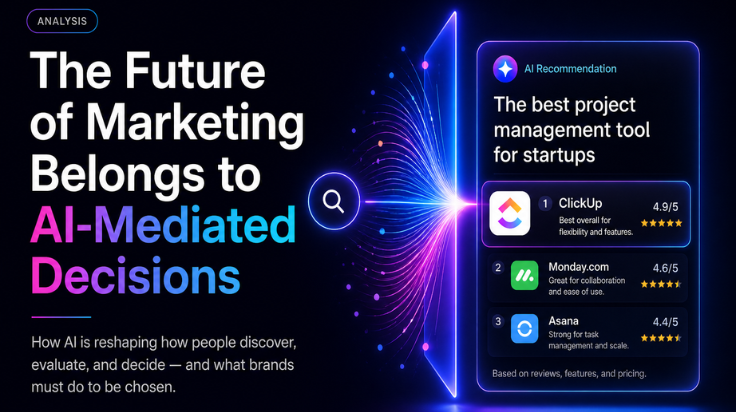
The end of search: Why the future of marketing belongs to AI-mediated decisions

Here is the uncomfortable truth most marketers are only beginning to grasp: what is changing is not simply the channel, but the cognitive process through which consumers make decisions. For more than two decades, the dominant model was search. Individuals would go to Google, formulate a query, scan a hierarchy of links, compare options across multiple tabs, and gradually construct their own judgment. Entire industries were designed around that behavior. Search engine optimization, paid acquisition, review management, and affiliate content all converged toward a single objective, which was to capture attention at the moment of inquiry and convert it into a click.

What is emerging now is not merely a new platform competing for that attention, but a structural shift in how decisions are delegated. Increasingly, users are no longer interested in conducting the comparative labor themselves. Instead of searching, they ask. Instead of navigating a landscape of competing sources, they receive a synthesized answer. Instead of evaluating ten options, they are presented with a short list, often pre-filtered and implicitly ranked. AI, in this sense, is not just an additional layer in the marketing stack. It is a compression mechanism that sits between information and judgment, reducing complexity into a single, authoritative narrative.

This pattern is not unprecedented. If one looks historically, every major media transition has produced a similar redistribution of advantage. When newspapers dominated, those who understood how to shape narratives within editorial structures gained disproportionate influence, while others remained invisible. The rise of television rewarded those who could translate their value into visual storytelling at scale. The emergence of social media shifted power toward those who understood how to build direct, continuous relationships with audiences. In each case, there was a period during which the majority of actors continued to optimize for the previous paradigm, even as the center of gravity had already moved. The same inertia is observable today, as many organizations continue to invest heavily in traditional search visibility while underestimating the implications of AI-mediated discovery.

The critical distinction between these two paradigms can be understood by contrasting ranking with selection. In a search-driven environment, visibility is achieved through position within a list, and the user remains the ultimate arbiter, navigating among alternatives and exercising judgment. In an AI-driven environment, visibility is contingent upon inclusion within a synthesized response. The system itself performs the initial filtering, effectively collapsing a wide field of possibilities into a narrow set of recommendations. This compression of choice is not a marginal change; it fundamentally alters the distribution of attention. When an AI system responds to a query such as “the best sushi in Hell’s Kitchen,” it does not present an exhaustive catalog. It produces a curated subset, and in many cases, that subset becomes the entirety of the user’s consideration set.

This dynamic can be observed in everyday interactions. A user asks a question and receives a synthesized answer rather than a list of links. The next step is no longer exploration, but validation. The user evaluates whether the recommendation can be trusted. This shift is decisive because it moves the competitive battleground from simple exposure to the quality and credibility of representation. It is no longer sufficient to appear; a business must be described in a way that withstands scrutiny within a compressed decision space.

To understand how this representation is constructed, it is necessary to examine the informational substrate on which AI systems rely. These systems do not experience products or services directly; they interpret patterns across a distributed network of data. That network includes structured business information, large-scale review platforms such as Yelp, and editorial coverage from outlets like Eater or The Infatuation. It also incorporates brand-owned content, interviews, and any textual material that consistently describes what a business is and how it should be understood. AI does not invent narratives in isolation; it aggregates and resolves them. The crucial point is that this aggregation process favors coherence. When signals align, the resulting summary is strong and specific. When signals conflict, the summary becomes diluted and generic.

This requirement for coherence introduces a constraint that did not exist, or at least was less consequential, in the search era. In a fragmented environment, inconsistency could be tolerated because the user performed the work of reconciliation. A business might be described as affordable in one context and premium in another, and the user would interpret those differences in light of their own expectations. AI systems, by contrast, do not negotiate ambiguity in the same way. They resolve it. If the descriptors attached to a business are inconsistent, the system tends to converge toward a neutral, non-committal characterization. The consequence is a loss of distinctiveness. A restaurant that might, in reality, occupy a clearly defined position in the market is reduced to a generic category because its representation across sources lacks alignment.

This shift also forces a reconsideration of what has traditionally been described as the “hidden gem.” In previous digital environments, it was entirely possible for a business to thrive with limited visibility, relying on word-of-mouth, local reputation, or a loyal customer base. Discovery was often nonlinear and, at times, serendipitous. Consumers would stumble upon exceptional experiences through exploration, recommendations, or proximity.

In an AI-mediated discovery environment, that dynamic changes significantly. AI systems do not discover in the human sense; they do not wander, explore, or take chances on the unknown. They identify patterns. They elevate entities that are consistently described, frequently referenced, and coherently positioned across accessible sources of information.

The implication is not that hidden gems cease to exist, but that their invisibility becomes a structural disadvantage. Excellence that is not translated into consistent, machine-readable signals struggles to surface. A restaurant may offer extraordinary quality, but if it is not represented across the data ecosystem in a way that reinforces its identity, it is unlikely to be selected in a synthesized response.

This introduces a subtle but important shift in competitive dynamics. In a search-driven world, discovery could still reward the curious user willing to explore beyond the first few results. In an AI-driven world, the system performs that filtering on behalf of the user, narrowing the field before the individual even becomes aware of the alternatives. As a result, businesses are no longer competing solely on quality or even visibility, but on their ability to be legibly and consistently represented within the information structures that AI systems rely upon.

Recognizing this gap, a new category of companies is beginning to emerge, focused specifically on how brands are perceived by AI systems. Firms such as Profound operate at the intersection of data, content, and narrative consistency. Their role is not limited to traditional public relations or search optimization. Instead, they monitor how different AI systems describe a brand, identify discrepancies or weaknesses in that description, and engineer interventions that bring the underlying signals into alignment. This may involve securing higher-quality editorial mentions, restructuring brand-owned content, or encouraging more descriptive user-generated feedback. The objective is not simply to increase visibility, but to shape the synthesized narrative that AI systems will reproduce.

What is particularly revealing is that this shift is not only reflected in the products these companies build, but also in how they define talent. Profound, for instance, frames the emergence of the “marketing engineer” as a direct response to a structural imbalance in modern marketing: exponential growth in required output paired with linear growth in team capacity. The answer is not more campaigns or more headcount, but a new type of operator capable of building systems that automate, monitor, and continuously refine how a brand is represented across AI environments. In this model, marketing is no longer limited to communication; it becomes a form of applied systems design, where the objective is to influence not just what is said about a brand, but how that information is structured, distributed, and ultimately selected.

From a strategic standpoint, this evolution has several implications. The first is a shift from traffic generation to inclusion within decision outputs. It is no longer sufficient to rank highly; one must be selected as part of the answer. The second is a reweighting of signal quality. A large volume of shallow mentions is less valuable than a smaller number of authoritative, detailed sources that can anchor the narrative. The third is a move from keyword-centric optimization to narrative engineering. What matters is not the presence of specific terms, but the clarity and consistency of the story that emerges when all signals are combined.

For companies seeking to adapt, the practical steps are relatively straightforward, although their execution requires discipline. A business must first define a clear and differentiated positioning, articulated in precise language that can be repeated across all touchpoints. That positioning should then be reinforced consistently, whether in website copy, business listings, or external coverage. Efforts should be made to secure mentions in credible, high-trust publications, as these carry disproportionate weight in shaping AI-generated summaries. Customer reviews should be encouraged to move beyond generic praise toward more detailed descriptions of the experience, as specificity enhances the richness of the signal. Finally, organizations must begin to actively monitor how they are described by AI systems, treating those outputs not as curiosities but as indicators of how effectively their narrative has been encoded.

The deeper transformation, however, is conceptual. Marketing has long been oriented around capturing attention within an environment of abundance, under the assumption that consumers would engage in the cognitive labor necessary to evaluate options. AI reduces that labor by inserting an intermediary that performs initial judgment on behalf of the user. In doing so, it changes the locus of influence. The audience is no longer only the individual making the final decision, but also the system that frames the available choices. Brands that recognize this dual audience and learn to communicate effectively within it will gain a structural advantage. Those that do not may continue to exist, but increasingly outside the narrow set of options that AI systems deem worth presenting.

In that sense, the future of marketing is not defined by louder messaging or greater frequency, but by legibility. The brands that will prevail are those that can be clearly understood, consistently described, and confidently recommended by systems that operate on synthesis rather than search.


NYC Doormen Authorize Strike as Contract Fight Raises Pressure on Building Owners

Thousands of New York City doormen, superintendents, porters, and other residential building workers have voted to authorize a strike, setting up what could become the city’s first walkout of these workers in 35 years if a contract agreement is not reached by midnight Monday.

The workers are represented by 32BJ SEIU, which says roughly 34,000 employees are covered under the expiring contract. If negotiations fail, the strike could disrupt daily life for an estimated 1.5 million renters, condo owners, and co-op residents across the city. In many buildings, residents would suddenly have to manage tasks normally handled by staff, from packages and trash to hallway upkeep and front-door coverage.

At the center of the dispute are familiar but increasingly explosive issues in New York: wages, pensions, and health care. The union says building owners want workers to start contributing to health insurance premiums and are also seeking to create a lower-paid classification for new hires. Union leaders argue that these proposals would erode standards for a workforce that already struggles to keep up with the cost of living in the New York metro area.

According to the union, doorpersons earn about $62,000 a year on average, though pay varies by role. Union President Manny Pastreich accused building owners of trying to reduce labor costs at the expense of workers who help keep residential buildings functioning every day. The union is also pushing for higher wages and stronger pension protections, though it has not yet publicly detailed a precise wage proposal.

Building owners, represented by the Realty Advisory Board on Labor Relations, argue that they too are under growing financial pressure. The group says rising costs are squeezing the industry, particularly as city politics shift and as Mayor Zohran Mamdani pushes for a rent freeze on the city’s roughly 1 million rent-stabilized apartments. The board maintains that controlling costs is necessary for the long-term sustainability of both the buildings and the workforce they employ.

The potential strike has already drawn political attention. Mamdani and other elected Democrats joined the workers’ demonstration in Manhattan, signaling the broader symbolic weight of this labor battle. This is not just a contract dispute over one sector. It sits at the intersection of labor rights, housing costs, rent politics, and the question of who is expected to absorb financial pressure in an increasingly unaffordable city.



That is what makes this standoff especially significant. Doormen and building staff are often invisible until they are gone, yet they play an essential role in the daily functioning of city life, especially in large residential buildings. Their work goes far beyond opening doors. They manage deliveries, assist residents, help maintain safety and cleanliness, and in some cases handle physically demanding maintenance tasks that keep older buildings running.

The last strike by these workers took place in 1991 and lasted 12 days. Since then, the union has authorized strikes at times without ultimately walking out. Whether this latest showdown ends in a deal or an actual strike, it has already exposed deeper tensions in New York over labor, affordability, and the future of urban living.

Alpheva AI and the Transformation of Financial Management: Rethinking Access, Decision-Making, and the Role of Intelligence

The promise of modern financial technology has long been framed around access. More tools, more data, more visibility. Yet, despite this proliferation, financial anxiety remains pervasive, and poor decision-making continues to undermine long-term stability for millions of individuals. This contradiction reveals a fundamental misunderstanding of the problem. Financial difficulty is not primarily a failure of access to information. It is a failure of structured guidance.

In a recent conversation on Atypical Journey, Lord Munjal, founder and CEO of Alpheva AI, articulates a distinction that is often overlooked. The gap between those who consistently make sound financial decisions and those who struggle is not simply a matter of discipline or effort. It is rooted in the presence or absence of a coherent decision-making framework. Individuals operating within well-advised environments, whether through professional advisors or institutional exposure, are not navigating financial complexity alone. Their decisions are informed, contextualized, and aligned with longer-term strategies.

By contrast, the majority of individuals manage their financial lives through fragmented systems. Budgeting tools, banking applications, credit monitoring platforms, and investment dashboards operate in isolation from one another. Each provides partial visibility, but none offers a unified interpretation of the overall financial situation. The result is a reactive mode of decision-making, where individuals respond to immediate pressures rather than act within a structured plan. Over time, this fragmentation produces not only inefficiency but also uncertainty, reinforcing a persistent sense of financial instability.

It is within this context that Alpheva AI positions itself as a departure from conventional financial applications. Rather than functioning as a passive tool for tracking or reporting, the platform seeks to operate as an active layer of intelligence. By integrating data across multiple financial dimensions and aligning it with individual goals, Alpheva aims to produce continuous, personalized guidance. The objective is not simply to inform users of their current position, but to assist them in determining what actions should follow.

This shift from visibility to interpretation is significant. Financial management, when reduced to dashboards and metrics, remains descriptive rather than prescriptive. It tells individuals what is happening without necessarily clarifying what should be done. Effective financial decision-making, however, requires the ability to evaluate trade-offs, anticipate outcomes, and adjust strategies over time. Historically, this level of insight has been accessible primarily through human advisors, often at a cost that limits widespread access. The introduction of AI into this space attempts to replicate aspects of that advisory function at scale.

However, the integration of artificial intelligence into financial decision-making raises complex questions that extend beyond efficiency. The issue of trust becomes central. Financial decisions carry long-term consequences, and reliance on algorithmic guidance introduces uncertainty regarding accountability. If a recommendation leads to suboptimal outcomes, the distribution of responsibility between user, platform, and system design is not immediately clear. Moreover, the assumption that AI can operate as a neutral and objective advisor must be examined critically. All models are shaped by underlying data, assumptions, and design choices, which inevitably influence the recommendations they produce.

There is also a broader structural consideration. While platforms such as Alpheva aim to democratize access to financial intelligence, their effectiveness depends on how they are adopted and utilized. Technology has the capacity to reduce disparities, but it can also reinforce them if only certain segments of the population fully leverage its capabilities. The question is not simply whether AI can improve financial outcomes, but whether it can do so in a way that meaningfully alters existing patterns of inequality.

Lord Munjal’s own trajectory, spanning leadership roles in major financial institutions and multiple entrepreneurial ventures, reflects an understanding of both the strengths and limitations of traditional financial systems. His experience highlights a recurring tension between structured environments, where decision-making is guided by established frameworks, and entrepreneurial contexts, where uncertainty requires a different form of judgment. This dual perspective informs the design philosophy behind Alpheva, which seeks to bring a level of strategic coherence to individuals who would otherwise operate without it.

Ultimately, the emergence of AI-driven financial management signals a broader transformation in how individuals engage with money. The shift is not merely technological, but conceptual. It challenges the assumption that financial competence is solely an individual responsibility and introduces the possibility that structured, intelligent systems can augment human decision-making in meaningful ways. Whether this potential is fully realized will depend not only on the sophistication of the technology, but also on the extent to which it is trusted, understood, and integrated into everyday financial behavior.

This article captures only a portion of a broader and more nuanced conversation. In the full episode of Atypical Journey, we explore the deeper roots of financial anxiety, the limits of traditional financial literacy, the realities of building and scaling ventures, and the growing role of AI in shaping financial decision-making. Watch the full episode below to explore the conversation in its entirety.


Mamdani, Hochul Announce New York’s First Pied-à-Terre Tax on Luxury Secondary Homes

Mayor Zohran Mamdani and Governor Kathy Hochul announced a proposal to create New York State’s first pied-à-terre tax, a measure aimed at raising revenue by taxing high-value secondary properties owned by people whose primary residence is outside New York City.

According to the announcement, the tax would apply to one- to three-family homes, condominiums, and co-ops valued above $5 million when the owner’s main home is located outside the city. City and state leaders say the measure is designed to target ultrawealthy individuals who keep luxury New York properties as secondary residences or investment assets rather than as full-time homes.

The administration says the new tax could generate about $500 million a year, money that would help address New York City’s budget gap while protecting public services. Officials also noted that similar proposals had been discussed for years under previous administrations, but this would be the first time such a tax is actually enacted in New York State.

In a video posted on X, Mamdani tied the announcement directly to one of the core promises of his campaign. “When I ran for mayor, I said I was going to tax the rich. Well, today, we’re taxing the rich,” he said. He described the measure as targeting the “richest of the rich,” specifically people who “store their wealth in New York City real estate but who don’t actually live here.”

Mamdani also said the revenue would help fund initiatives such as free childcare, cleaner streets, and safer neighborhoods. Framing the issue as one of fairness, he said everyone has a role to play in contributing to the city, “and some a little bit more than others.” He also called the current structure “a fundamentally unfair system that hurts working New Yorkers” and said, “Now, it’s coming to an end.”

In a statement, Mamdani said the measure would help balance the budget in a fairer way by requiring wealthy property owners to contribute more, rather than placing the burden on working New Yorkers. Hochul also defended the proposal, saying that owners of multimillion-dollar second homes should contribute more to the city they benefit from.

The announcement is politically notable because it reflects themes Mamdani emphasized during his rise in city politics. Running as a democratic socialist, he has consistently argued that New York should ask more of the wealthy in order to fund public services and ease pressure on ordinary residents facing the city’s high cost of living.

If approved, the pied-à-terre tax would mark a significant shift in how New York taxes luxury real estate tied to out-of-city and global wealth.

World Bank Group Launches Water Forward Initiative to Improve Water Security for 1 Billion People by 2030

The World Bank Group announced on April 15 the launch of Water Forward, a new global initiative designed to improve water security for 1 billion people by 2030. The platform brings together multilateral development banks, development finance institutions, governments, philanthropies, and private sector partners in an effort to better align policy reforms, financing, and partnerships around one of the most urgent development challenges facing the world.

The initiative is intended to help countries expand reliable water services while also strengthening their systems against droughts and floods. Beyond its importance for daily life, water is a central driver of economic stability and growth. It supports public health, food production, energy systems, and employment on a massive scale. The World Bank estimates that 1.7 billion jobs worldwide depend on water, yet 4 billion people still experience water scarcity.

According to the World Bank Group, many developing countries have struggled to make progress because of weak regulations, unclear policy environments, and water utilities that are not financially sustainable. These conditions have often limited service delivery and discouraged investment in the sector. Water Forward aims to respond to those barriers by helping governments strengthen institutions, improve financial performance, and prepare projects that are ready to attract investment.

A key part of the initiative is the creation of country-led water compacts, through which governments define their own reform priorities and establish a roadmap for investment in the water sector. So far, 14 countries have announced national water compacts under the initiative, while additional countries are expected to join in the coming months.

World Bank Group President Ajay Banga framed the issue as both a development and economic priority. He said reliable water systems are essential for farmers to produce, for businesses to operate, and for cities to attract investment. In that sense, improving water access is not only a matter of basic services, but also a condition for job creation and long-term productivity.

The World Bank Group says it is committed to helping deliver water security to 400 million people by 2030. With the participation of its partners, the broader Water Forward platform is expected to reach more than 1 billion people over the same period. The initiative comes at a time when developing countries are also preparing for major demographic pressures, with more than 1.2 billion young people expected to enter the workforce over the next 10 to 15 years.

Several major international financial institutions have already pledged support for the effort. They include the Asian Development Bank, Asian Infrastructure Investment Bank, Council of Europe Development Bank, European Bank for Reconstruction and Development, European Investment Bank, Inter-American Development Bank, Islamic Development Bank, New Development Bank, OPEC Fund for International Development, and the International Fund for Agricultural Development.

With Water Forward, the World Bank Group and its partners are seeking to accelerate reforms and investment in a sector that is increasingly seen as foundational to resilience, private sector growth, and economic opportunity. As water stress intensifies across many parts of the world, the initiative reflects a growing recognition that water security is not a peripheral issue, but a central pillar of development.

Trump Removes Homeland Security Secretary Kristi Noem After Mounting Controversies

President Donald Trump announced Thursday that he is removing Kristi Noem from her role as Secretary of the Department of Homeland Security, replacing her with Republican Senator Markwayne Mullin of Oklahoma. The transition is expected to take effect on March 31 and represents the first major cabinet shakeup of Trump’s second presidential term.

In a message posted on Truth Social, Trump praised Noem’s work on border security, stating that she had delivered “numerous and spectacular results.” However, the decision comes after weeks of political pressure tied to controversies surrounding her leadership of the department.

Noem, a former governor of South Dakota and longtime Trump ally, had become one of the most visible figures behind the administration’s immigration enforcement strategy. The Department of Homeland Security oversees Immigration and Customs Enforcement (ICE), Border Patrol and several other agencies that have played a central role in Trump’s mass deportation policy.

Her tenure took a dramatic turn after two U.S. citizens, Renee Good and Alex Pretti, were killed in Minneapolis during operations involving federal immigration agents. Noem publicly described both individuals as “domestic terrorists,” a characterization that was quickly challenged by civil liberties groups and lawmakers who said the evidence did not support the claim. The incidents triggered investigations and calls for accountability from Democrats and some Republicans, who questioned the department’s conduct and leadership.

At the same time, reports surfaced about an alleged personal relationship between Noem and Corey Lewandowski, a former Trump campaign manager who served as a senior adviser within the department. According to reporting by the Wall Street Journal, the relationship and internal management tensions contributed to an increasingly unstable atmosphere at DHS.

Questions also emerged about spending decisions inside the department, including approximately $220 million awarded to a firm linked to Noem’s former spokesperson to produce advertising campaigns prominently featuring the secretary. The growing scrutiny placed the department under unusual bipartisan pressure. Senator Thom Tillis of North Carolina threatened to block Senate business if DHS did not answer oversight questions, while Senator John Kennedy of Louisiana publicly questioned the advertising contracts during congressional hearings.

Despite the controversies, Trump did not criticize Noem in his announcement. Instead, he said she would take on a new role as special envoy for what he called the “Shield of the Americas,” a security initiative that the administration plans to unveil in the coming days.The appointment of Senator Mullin suggests the White House is seeking to reset leadership at a department that remains central to Trump’s political agenda.

For an administration that has made immigration enforcement one of its defining policies, the leadership change signals both the political sensitivity of the issue and the high stakes surrounding the agencies tasked with carrying it out.

NYPD responds to unruly crowd of teens at Bay Plaza on Presidents’ Day

BRONX — What began as a school holiday quickly escalated into a scene of disorder outside The Mall at Bay Plaza on Presidents’ Day.

Shortly after 2 p.m., the NYPD responded to reports of a large and disruptive crowd gathering near the shopping center. Authorities estimated that between 100 and 200 youths had assembled outside the mall. Officers issued multiple dispersal orders as tensions rose.

Videos circulating on social media show groups running, shouting and pushing, with visible confrontations and several juveniles being detained. Police confirmed that individuals were taken into custody, though the exact number of arrests and potential charges has not yet been released. The investigation remains ongoing.

Beyond the viral footage, the incident raises deeper questions.

What prompts such a large number of teenagers to gather in a commercial space on a day off from school? Was the meetup coordinated online? Was it spontaneous? Or does it reflect something more systemic: limited access to structured activities, insufficient recreational programming, or the digital amplification of crowd behavior?

Shopping malls have historically functioned as informal gathering spaces for young people. Yet they are privately managed commercial environments, governed by rules designed to protect businesses and paying customers. When large groups of minors congregate without clear purpose or supervision, friction often follows.

Layer onto that the influence of social media, where moments of conflict are filmed, shared and sometimes encouraged in real time, and escalation can become performative.

The incident also enters the broader national conversation about youth behavior and law enforcement response. Police face expectations to maintain order swiftly, particularly in crowded public settings. At the same time, images of minors being restrained or arrested generate concern about proportionality and long-term consequences. Even when juvenile records are sealed, encounters with the justice system can alter educational and employment pathways.

Reducing the event to “rowdy teens” oversimplifies the dynamic. Framing it solely as over-policing does the same.

The Bay Plaza disturbance sits at the intersection of youth culture, digital mobilization, commercial space and public authority. If the response centers only on punishment, the immediate disruption may subside. If the response includes investment in programming, mentorship and safe gathering spaces, the long-term trajectory could look different.

Namketa Media will continue monitoring official updates as more details are released.

yourUSA.ai founder Jules Kadher Kabore

yourUSA.ai Launches AI-Powered Platform to Simplify USCIS Immigration and Government Forms

AUSTIN — February 12, 2026 — yourUSA.ai, a new AI-powered, web-based form-filling assistant, officially launched today with a clear mission: to simplify one of the most stressful parts of immigration and government processe: paperwork.

From U.S. Citizenship and Immigration Services (USCIS) applications to passport and visa forms, official documents can be confusing, repetitive, and intimidating. Even minor mistakes can lead to delays, requests for evidence, or costly consequences. For immigrants and first-time applicants, the experience can feel overwhelming.

yourUSA.ai aims to reduce that friction. The platform provides a conversational, step-by-step interface that guides users through complex forms in plain language. Instead of navigating dense PDFs filled with technical instructions, users answer structured questions in a clear, human-centered flow. The system then compiles the information into the appropriate form and provides practical next steps, including filing fees, required documentation checklists, and submission guidance.

The initial release supports high-demand documents including USCIS immigration forms, U.S. passport applications, and visa-related forms such as the DS-160.

Built from lived experience

yourUSA.ai was founded by Jules Kadher Kabore, a Burkinabè-American software engineer whose own immigration journey revealed how unforgiving government paperwork can be.

Despite being educated and highly motivated, Kabore found the process filled with ambiguity and repetitive questions. The risk of small errors with disproportionate consequences left a lasting impression.

“In this age of AI, form-filling should be painless,” Kabore said. “The forms look simple, but even a small misunderstanding can create major difficulty. That’s the problem we’re solving.”

Kabore emphasizes that yourUSA.ai does not provide legal advice and does not replace attorneys. Instead, it functions as an intelligent assistant designed to improve clarity, consistency, and user confidence.

A founder bridging Silicon Valley and West Africa

Kabore earned his degree in Computer Science from the University of California, Santa Cruz, and later joined General Motors as a software engineer. Alongside his corporate career, he launched multiple technology ventures focused on real-world challenges.

He founded SANK Money, a peer-to-peer payment platform built to increase financial inclusion within African communities. He also created Kaset Toumde, a workplace attendance and performance review system tailored to African organizational contexts. Through King Management, he continues to build cross-continental technology initiatives.

His entrepreneurial journey has not followed the typical venture-backed narrative. Kabore has spoken openly about the structural barriers faced by Black and immigrant founders in tech, including limited access to capital and networks. Rather than waiting for investor validation, he has often chosen to bootstrap, iterate quickly, and focus on customer needs.

That philosophy directly shaped yourUSA.ai. Instead of chasing hype, Kabore focused on a practical problem affecting millions: completing essential government forms accurately and confidently.

Responsible AI in sensitive processes

Immigration paperwork involves sensitive personal information, and conversations around AI, data privacy, and digital trust continue to evolve. Kabore states that transparency and responsible technology use are central to the platform’s design.

The long-term vision for yourUSA.ai extends beyond individual users. Potential future partnerships could include immigration attorneys, legal service providers, and community organizations seeking to improve accessibility and reduce administrative burden.

At its core, yourUSA.ai reflects a broader belief: technology should lower barriers, not raise them. For immigrants, students, families, and travelers navigating critical life transitions, clarity can make all the difference.

More information is available at https://www.yourUSA.ai.

Namketa Media Mitown Shooting

Gunfire in broad daylight near Times Square leaves one man dead

MIDTOWN, Manhattan — A fatal shooting inside a 7-Eleven near West 39th Street and Eighth Avenue disrupted a busy Midtown morning on Thursday, sending shockwaves through one of New York City’s most heavily trafficked corridors.

According to the NYPD, the incident occurred just before 10:30 a.m. Witnesses reported that two men entered the convenience store engaged in a heated argument. Within moments, one of the men pulled out a firearm and shot the other in the neck. The suspect fled the scene onto Eighth Avenue, while the victim collapsed inside the store. He was pronounced dead shortly thereafter.

By late morning, the area had been cordoned off with police tape. Detectives remained on site for hours, reviewing surveillance footage from the store and neighboring businesses in an effort to identify and locate the shooter. The Office of the Chief Medical Examiner removed the victim’s body within the hour, as officers examined personal belongings recovered outside the store.

Local residents told Namketa Media that the victim was a familiar presence in the area, often seen holding the door open for customers in exchange for small tips. A friend, speaking on condition of anonymity, said the man was homeless and originally from the Bronx. Authorities believe he was in his 40s, though his identity has not yet been released pending family notification.

The store is located just steps from the Port Authority Bus Terminal and within walking distance of Times Square and the Theater District, an area that draws thousands of commuters and tourists daily. The shooting left many visibly shaken. Some visitors paused in disbelief; nearby workers expressed frustration and concern over ongoing public safety challenges in the neighborhood.

As a resident of Midtown, I am struck by the stark contrast this area often presents. On one side, the energy of Broadway and global tourism. On the other, visible hardship,  homelessness, untreated mental illness, and escalating tensions that too often go unaddressed. Thursday’s shooting unfolded in broad daylight, underscoring the vulnerability of public spaces even in the city’s most iconic districts.

Police say they have obtained clear images of the suspect from surveillance cameras. He is described as a man wearing a green puffer coat and dark pants. The investigation remains ongoing.

Anyone with information is urged to contact the NYPD Crime Stoppers hotline.

VOTER ID

If only citizens can vote, why is voter ID controversial?

The debate around the SAVE America Act and Voter ID has moved from a technical discussion about election rules into a broader political battle that is now shaping the national agenda.

President Trump has made the bill a personal priority, publicly pressuring House Republicans to pass it. In the Senate, the bill likely faces a Democratic filibuster, prompting some Republicans to float reviving a talking filibuster. Senate Minority Leader Chuck Schumer has accused Republicans of trying to revive “Jim Crow–type laws,” arguing that the SAVE Act would roll back voting rights rather than protect them.

But What struck me most is not simply how polarized this conversation has become, but how little I actually understood about how voting currently works in the United States before this moment. For years, I’ve known that even green card holders could not vote and had to wait until they became  citizens. I also assumed, without questioning it, that there were already clear and consistent systems in place to ensure that only American citizens participated in American elections. The fight over voter ID and the SAVE America Act forced me to confront the fact that this assumption was incomplete.

Let’s start with something everyone agrees on: under U.S. law, only American citizens can vote in federal elections. Since 1996, it has been a federal crime for noncitizens to vote, punishable by up to one year in prison. Voting is not just a formality. It is tied directly to what it means to be a citizen. Yet the way this rule is enforced is far less strict than I had imagined. In most states today, when someone registers to vote, they are not required to present documentary proof of citizenship such as a passport or birth certificate. Instead, they sign a statement affirming that they are a U.S. citizen under penalty of perjury. On Election Day, some states require identification, while others do not. Even in states that require ID, that identification usually proves who you are, not that you are a citizen. A driver’s license, for example, does not establish citizenship. In practice, this means the system relies primarily on people telling the truth when they register, and the possibility of punishment later rather than verifying citizenship upfront.

This is the context in which the SAVE America Act has become so controversial. At its core, the bill proposes a more straightforward system: require proof of citizenship such as a passport, birth certificate, or REAL ID indicating citizenship to register to vote, and require photo ID to vote in every state. It would also largely eliminate mail-only voter registration by requiring people to present documents in person. There is an exception process for people who cannot immediately provide documents, but the overall standard would be much stricter than what exists today.

Supporters of the bill argue that this is simply common sense. And I am increasingly inclined to agree with them. If voting is reserved for citizens which it legally is,  then asking for proof of citizenship should not be controversial. To me, that is not partisan. It is basic logic. We require proof of identity and eligibility for far less consequential things every single day, yet when it comes to choosing the leaders of a country, suddenly this becomes “extreme.”

Opponents warn that stricter requirements could disenfranchise millions of legitimate voters who may not have easy access to documents like passports or birth certificates. They argue that many elderly, rural, or low-income Americans could be unfairly excluded. I take that concern seriously because access matters in a democracy. But this is where I part ways with much of the opposition is that just as noncitizen voting is statistically rare, I also believe that Americans who genuinely want to vote but are completely unable to obtain any form of identification or proof of citizenship are also rare. In everyday life, ID is already required for so many ordinary activities: opening a bank account, boarding a plane, getting a job, entering many buildings, receiving medical care, picking up certain packages, and even buying alcohol at a bar. So when I hear that there is a massive population of Americans who function in society but somehow cannot obtain a single document proving who they are, I find that very difficult to accept.

Even if we assume that some people would struggle, I do not think the solution should be to abandon reasonable safeguards altogether. If the concern is that some Americans might not have easy access to documents, then the rational response is not to weaken election integrity, it is to make those documents easier, faster, and cheaper to obtain. We should put mechanisms in place to help people retrieve their birth certificates, get state IDs, or passports. Provide assistance, reduce fees, expand access points, and simplify processes. That, to me, would be the sensible compromise.

It is also important to be clear about the trade-off. Recent audits in several states have found real instances of noncitizens on voter rolls, and in some cases, evidence that a limited number may have cast ballots. These numbers are small relative to the overall electorate but they show that the issue is not imaginary. So we are weighing two risks: that of election fraud, and a risk of eligible voters facing hurdles. Between those two, the choice feels like a no-brainer to me. I think it makes more sense to tighten safeguards to protect the vote, while helping people get the documents they need, rather than leave a loophole in the system. If citizenship is the foundation of voting rights, then proof of citizenship should carry real meaning.

Ultimately, this debate is not just about paperwork or party politics. It raises deeper questions about what voting represents, how much trust we place in our institutions. So I end with a genuine challenge to readers: if you oppose voter ID and proof of citizenship requirements, explain your position in good faith. Is it that you are comfortable with some noncitizens voting? That you believe there is no real risk of that happening? Or do you truly think so many Americans are unable to get basic documents that stricter rules would be unjust?