

Tag Archive for: Artificial Intelligence

DMWF: AI Can Produce More Content. Can It Build a Stronger Brand?

When I attended DMWF North America 2026 at the Javits Center in New York, there was little doubt about what would dominate the conversation. Marketing leaders, technology companies and AI platforms had gathered to talk about what is next for the industry, and AI came up everywhere: alongside customer journey, customer insights, search visibility, content creation and the changing ways people discover information. I wanted to spent the day following those conversations and speaking with marketers and industry leaders about what we should actually be paying attention to as the profession changes.

I went into those conversations with a question that I think is becoming more important as AI becomes easier to use. We already know that it can help marketers produce more content and complete certain tasks faster. What I wanted to understand was what happens beyond that efficiency. Does producing more necessarily make marketing better? Does automating more of the work make a brand stronger? And as the same technology becomes available to almost everyone, where does the real competitive advantage remain?

One of the most optimistic perspectives came from Nisha Mantukani, CMO of Nas.com. She explained that Nas builds AI agents that can be deployed into marketing teams, with the goal of giving smaller businesses the ability to market with capabilities closer to those of a Fortune 500 company. When I asked whether she was worried about the direction AI could take, she compared the fear surrounding it to earlier technological revolutions. New technologies, in her view, have always attracted people who believed they were impossible, dangerous or overhyped before eventually becoming part of everyday life.

I pushed the question further because the concerns around AI are not only about jobs. Some experts have warned about increasingly autonomous systems and the possibility that we may eventually develop technology that is difficult to control. Mantukani acknowledged that mistakes will happen and that more advanced systems may create some chaos along the way, but she remained optimistic about our ability to adapt. More importantly for marketers, she said Nas.com keeps a human in the loop and does not believe in a future in which AI completely replaces people. Her preferred model is one where the human and the AI work together toward an outcome.

That distinction gets closer to how I think marketers should be looking at AI. The most valuable question is not whether we can automate something. It is whether automating it actually improves the outcome. A smaller company being able to accomplish work that once required a much larger marketing department is significant. AI can lower the cost of execution and expand what a small team is capable of doing. But access to the same tools does not automatically give every company good positioning, a clear point of view or an understanding of why customers should choose it.

That became even clearer in my conversation with Danny Peters, Vice President of Business Development at Elements Media Solutions. His use case for AI was much less about generating marketing content and much more about dealing with the enormous amount of content companies already have. Elements provides a media workflow ecosystem that helps teams manage and locate their assets, regardless of where those assets are stored. Peters described AI as a practical tool for making that process more efficient.

When I asked him whether he saw AI as a threat to professions, he said he viewed it as a tool rather than something simply taking over a person’s job. He gave examples such as transcription, translation and using AI to add contextual information to photographs and other media. A file may contain technical metadata without actually describing what appears in the image; AI can help add that context so the asset becomes easier to find and use later. In his example, the content is still something humans produced. AI helps people organize it and work with it more efficiently.

I found that perspective particularly relevant because marketing has spent years moving toward more and more content. Brands are expected to publish constantly, create for multiple platforms, produce video, repurpose that video, personalize messages and maintain huge libraries of creative assets. Now AI is making it possible to accelerate that production even further. At some point, however, the challenge is no longer creating another piece of content. It is knowing what you already have, why it exists and how to use it intelligently.

That is where I think the obsession with output can become misleading. A marketing team can technically become more productive while becoming less coherent. If AI allows you to create twenty versions of something instead of five, that does not mean any of those twenty versions says the right thing. Efficiency is valuable, but efficiency without direction simply allows a company to move faster in whatever direction it was already going.

My conversation with Noah from Spikerz introduced another dimension of that problem: the more a brand builds online, the more it also has to protect. Spikerz focuses specifically on social media security. Noah explained that its work falls broadly into account protection and brand protection. On the account side, that includes helping ensure social media accounts are not breached and putting governance protocols in place so that the right people have access and the wrong people do not. On the brand side, Spikerz uses AI for functions including comment moderation, detecting scams, spam and phishing, removing harmful activity and identifying impersonator accounts.

That conversation showed another side of the AI story. I asked Noah about the contradiction of using AI for security when AI itself can also amplify the problem. Someone can use it to create fake identities, scale bots or imitate people and brands much faster than before. He agreed with the premise: AI in the right hands can be used for good, while in the wrong hands it can be used for harm. He pointed out that activity that once required someone manually creating one or two impersonation accounts can now be scaled dramatically with the same resources. Spikerz’s role, as he described it, is to use AI on the defensive side to identify that activity and remove it.

For marketers, that is not merely a cybersecurity issue. It is a branding issue. A brand is not only the content a company deliberately puts into the world. It is also the trust people attach to its name, its accounts and its communications. If someone impersonates that brand convincingly enough, or compromises one of its platforms, the damage reaches beyond IT. It affects the relationship the company has spent years building with its audience.

A fourth conversation, with the team from Blings, brought the discussion back to content but added an important nuance. Blings describes its technology as a new kind of personalized and interactive video format. The team explained that its videos can connect to customer data so that the experience can change based on the individual watching, including personalized information, shopping functionality and different customer journeys.

When I asked for their take on AI, they described themselves as AI-forward but also drew a line around where they believe AI works best. They use it for optimization, data, parts of the production process and determining customer journeys, but they were careful about relying on it too heavily for creative work. One of the team members noted that enterprise clients often have strict brand guidelines and that consumers are not always receptive to obviously AI-generated material. The challenge, she said, is knowing the difference between good content and content that starts to become sloppy. Another member of the team pointed out that AI can hallucinate if it is not properly constrained, while their designers and creative partners remain involved in making the content itself. Their summary was simple: they use AI to optimize rather than to replace the creative process.

That may have been one of the most important observations I heard during the day because it touches directly on a tension I see in marketing right now. There is enormous excitement around what AI can generate, but brands cannot afford to confuse generation with judgment. A technically impressive output can still be off-brand. A piece of content can look polished and still say nothing distinctive. A campaign can be produced in record time and still fail because the positioning behind it was weak.

My takeaway from DMWF was therefore not that AI is replacing marketing. It was that AI is making the distinction between marketing execution and marketing thinking much harder to ignore. The execution side is becoming easier. Creating variations, translating copy, organizing assets, analyzing data, personalizing experiences and automating workflows can all happen at a scale that would have been difficult for many teams only a few years ago. That is a real advantage, and dismissing it would be a mistake.

But easier execution also raises the value of the things that are not solved simply by pressing a button. Someone still has to decide what the company wants to be known for, which audience matters, which message deserves repetition and which idea may perform well in the short term while weakening the brand over time. Someone has to understand the difference between following a trend and having a strategy.

I think that is where the discussion about AI and marketing needs to become more sophisticated. We spend a lot of time asking how much faster AI can help us work. We should spend just as much time asking what all of that additional output is supposed to accomplish.

The companies I spoke with at DMWF were approaching the technology from very different angles. Nas.com is using AI to expand what marketing teams can do. Elements is using it to make enormous libraries of human-created content easier to manage. Spikerz is using it to defend brands against threats that AI itself can help scale. Blings is using it to optimize personalized video while deliberately keeping human creativity at the center of the work. Taken together, those conversations did not leave me with the impression that humans are becoming irrelevant. They left me with almost the opposite conclusion.

As AI takes over more of the mechanical work, human judgment becomes more visible. If everyone can produce more content, producing more will stop being much of a differentiator. The advantage will belong to companies that know what is worth producing in the first place, how it connects to their positioning and how to protect the trust they build around it.

AI can help a brand move faster. It can help a team do more. It can help organize, personalize and protect the work. But a stronger brand still requires something more fundamental: clarity about what you want people to associate with your name. That part of marketing has not been automated yet.
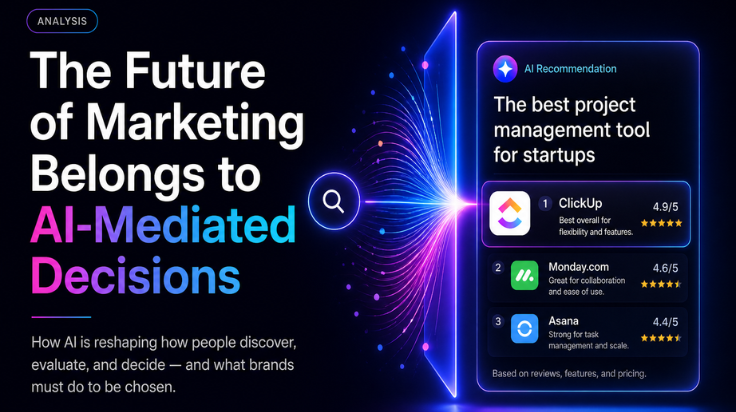
The end of search: Why the future of marketing belongs to AI-mediated decisions

Here is the uncomfortable truth most marketers are only beginning to grasp: what is changing is not simply the channel, but the cognitive process through which consumers make decisions. For more than two decades, the dominant model was search. Individuals would go to Google, formulate a query, scan a hierarchy of links, compare options across multiple tabs, and gradually construct their own judgment. Entire industries were designed around that behavior. Search engine optimization, paid acquisition, review management, and affiliate content all converged toward a single objective, which was to capture attention at the moment of inquiry and convert it into a click.

What is emerging now is not merely a new platform competing for that attention, but a structural shift in how decisions are delegated. Increasingly, users are no longer interested in conducting the comparative labor themselves. Instead of searching, they ask. Instead of navigating a landscape of competing sources, they receive a synthesized answer. Instead of evaluating ten options, they are presented with a short list, often pre-filtered and implicitly ranked. AI, in this sense, is not just an additional layer in the marketing stack. It is a compression mechanism that sits between information and judgment, reducing complexity into a single, authoritative narrative.

This pattern is not unprecedented. If one looks historically, every major media transition has produced a similar redistribution of advantage. When newspapers dominated, those who understood how to shape narratives within editorial structures gained disproportionate influence, while others remained invisible. The rise of television rewarded those who could translate their value into visual storytelling at scale. The emergence of social media shifted power toward those who understood how to build direct, continuous relationships with audiences. In each case, there was a period during which the majority of actors continued to optimize for the previous paradigm, even as the center of gravity had already moved. The same inertia is observable today, as many organizations continue to invest heavily in traditional search visibility while underestimating the implications of AI-mediated discovery.

The critical distinction between these two paradigms can be understood by contrasting ranking with selection. In a search-driven environment, visibility is achieved through position within a list, and the user remains the ultimate arbiter, navigating among alternatives and exercising judgment. In an AI-driven environment, visibility is contingent upon inclusion within a synthesized response. The system itself performs the initial filtering, effectively collapsing a wide field of possibilities into a narrow set of recommendations. This compression of choice is not a marginal change; it fundamentally alters the distribution of attention. When an AI system responds to a query such as “the best sushi in Hell’s Kitchen,” it does not present an exhaustive catalog. It produces a curated subset, and in many cases, that subset becomes the entirety of the user’s consideration set.

This dynamic can be observed in everyday interactions. A user asks a question and receives a synthesized answer rather than a list of links. The next step is no longer exploration, but validation. The user evaluates whether the recommendation can be trusted. This shift is decisive because it moves the competitive battleground from simple exposure to the quality and credibility of representation. It is no longer sufficient to appear; a business must be described in a way that withstands scrutiny within a compressed decision space.

To understand how this representation is constructed, it is necessary to examine the informational substrate on which AI systems rely. These systems do not experience products or services directly; they interpret patterns across a distributed network of data. That network includes structured business information, large-scale review platforms such as Yelp, and editorial coverage from outlets like Eater or The Infatuation. It also incorporates brand-owned content, interviews, and any textual material that consistently describes what a business is and how it should be understood. AI does not invent narratives in isolation; it aggregates and resolves them. The crucial point is that this aggregation process favors coherence. When signals align, the resulting summary is strong and specific. When signals conflict, the summary becomes diluted and generic.

This requirement for coherence introduces a constraint that did not exist, or at least was less consequential, in the search era. In a fragmented environment, inconsistency could be tolerated because the user performed the work of reconciliation. A business might be described as affordable in one context and premium in another, and the user would interpret those differences in light of their own expectations. AI systems, by contrast, do not negotiate ambiguity in the same way. They resolve it. If the descriptors attached to a business are inconsistent, the system tends to converge toward a neutral, non-committal characterization. The consequence is a loss of distinctiveness. A restaurant that might, in reality, occupy a clearly defined position in the market is reduced to a generic category because its representation across sources lacks alignment.

This shift also forces a reconsideration of what has traditionally been described as the “hidden gem.” In previous digital environments, it was entirely possible for a business to thrive with limited visibility, relying on word-of-mouth, local reputation, or a loyal customer base. Discovery was often nonlinear and, at times, serendipitous. Consumers would stumble upon exceptional experiences through exploration, recommendations, or proximity.

In an AI-mediated discovery environment, that dynamic changes significantly. AI systems do not discover in the human sense; they do not wander, explore, or take chances on the unknown. They identify patterns. They elevate entities that are consistently described, frequently referenced, and coherently positioned across accessible sources of information.

The implication is not that hidden gems cease to exist, but that their invisibility becomes a structural disadvantage. Excellence that is not translated into consistent, machine-readable signals struggles to surface. A restaurant may offer extraordinary quality, but if it is not represented across the data ecosystem in a way that reinforces its identity, it is unlikely to be selected in a synthesized response.

This introduces a subtle but important shift in competitive dynamics. In a search-driven world, discovery could still reward the curious user willing to explore beyond the first few results. In an AI-driven world, the system performs that filtering on behalf of the user, narrowing the field before the individual even becomes aware of the alternatives. As a result, businesses are no longer competing solely on quality or even visibility, but on their ability to be legibly and consistently represented within the information structures that AI systems rely upon.

Recognizing this gap, a new category of companies is beginning to emerge, focused specifically on how brands are perceived by AI systems. Firms such as Profound operate at the intersection of data, content, and narrative consistency. Their role is not limited to traditional public relations or search optimization. Instead, they monitor how different AI systems describe a brand, identify discrepancies or weaknesses in that description, and engineer interventions that bring the underlying signals into alignment. This may involve securing higher-quality editorial mentions, restructuring brand-owned content, or encouraging more descriptive user-generated feedback. The objective is not simply to increase visibility, but to shape the synthesized narrative that AI systems will reproduce.

What is particularly revealing is that this shift is not only reflected in the products these companies build, but also in how they define talent. Profound, for instance, frames the emergence of the “marketing engineer” as a direct response to a structural imbalance in modern marketing: exponential growth in required output paired with linear growth in team capacity. The answer is not more campaigns or more headcount, but a new type of operator capable of building systems that automate, monitor, and continuously refine how a brand is represented across AI environments. In this model, marketing is no longer limited to communication; it becomes a form of applied systems design, where the objective is to influence not just what is said about a brand, but how that information is structured, distributed, and ultimately selected.

From a strategic standpoint, this evolution has several implications. The first is a shift from traffic generation to inclusion within decision outputs. It is no longer sufficient to rank highly; one must be selected as part of the answer. The second is a reweighting of signal quality. A large volume of shallow mentions is less valuable than a smaller number of authoritative, detailed sources that can anchor the narrative. The third is a move from keyword-centric optimization to narrative engineering. What matters is not the presence of specific terms, but the clarity and consistency of the story that emerges when all signals are combined.

For companies seeking to adapt, the practical steps are relatively straightforward, although their execution requires discipline. A business must first define a clear and differentiated positioning, articulated in precise language that can be repeated across all touchpoints. That positioning should then be reinforced consistently, whether in website copy, business listings, or external coverage. Efforts should be made to secure mentions in credible, high-trust publications, as these carry disproportionate weight in shaping AI-generated summaries. Customer reviews should be encouraged to move beyond generic praise toward more detailed descriptions of the experience, as specificity enhances the richness of the signal. Finally, organizations must begin to actively monitor how they are described by AI systems, treating those outputs not as curiosities but as indicators of how effectively their narrative has been encoded.

The deeper transformation, however, is conceptual. Marketing has long been oriented around capturing attention within an environment of abundance, under the assumption that consumers would engage in the cognitive labor necessary to evaluate options. AI reduces that labor by inserting an intermediary that performs initial judgment on behalf of the user. In doing so, it changes the locus of influence. The audience is no longer only the individual making the final decision, but also the system that frames the available choices. Brands that recognize this dual audience and learn to communicate effectively within it will gain a structural advantage. Those that do not may continue to exist, but increasingly outside the narrow set of options that AI systems deem worth presenting.

In that sense, the future of marketing is not defined by louder messaging or greater frequency, but by legibility. The brands that will prevail are those that can be clearly understood, consistently described, and confidently recommended by systems that operate on synthesis rather than search.