
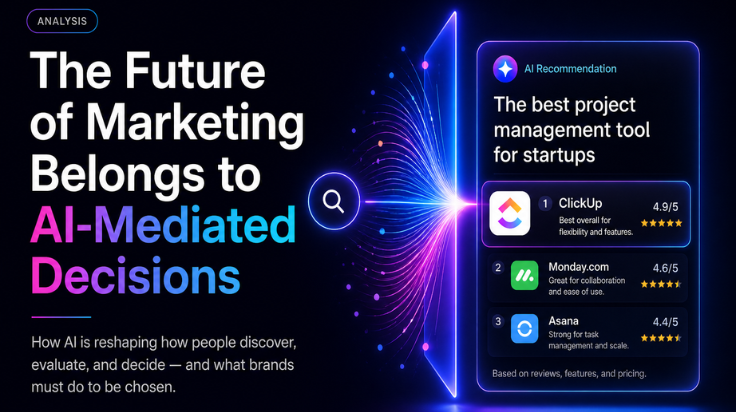
The end of search: Why the future of marketing belongs to AI-mediated decisions
Here is the uncomfortable truth most marketers are only beginning to grasp: what is changing is not simply the channel, but the cognitive process through which consumers make decisions. For more than two decades, the dominant model was search. Individuals would go to Google, formulate a query, scan a hierarchy of links, compare options across multiple tabs, and gradually construct their own judgment. Entire industries were designed around that behavior. Search engine optimization, paid acquisition, review management, and affiliate content all converged toward a single objective, which was to capture attention at the moment of inquiry and convert it into a click.
What is emerging now is not merely a new platform competing for that attention, but a structural shift in how decisions are delegated. Increasingly, users are no longer interested in conducting the comparative labor themselves. Instead of searching, they ask. Instead of navigating a landscape of competing sources, they receive a synthesized answer. Instead of evaluating ten options, they are presented with a short list, often pre-filtered and implicitly ranked. AI, in this sense, is not just an additional layer in the marketing stack. It is a compression mechanism that sits between information and judgment, reducing complexity into a single, authoritative narrative.
This pattern is not unprecedented. If one looks historically, every major media transition has produced a similar redistribution of advantage. When newspapers dominated, those who understood how to shape narratives within editorial structures gained disproportionate influence, while others remained invisible. The rise of television rewarded those who could translate their value into visual storytelling at scale. The emergence of social media shifted power toward those who understood how to build direct, continuous relationships with audiences. In each case, there was a period during which the majority of actors continued to optimize for the previous paradigm, even as the center of gravity had already moved. The same inertia is observable today, as many organizations continue to invest heavily in traditional search visibility while underestimating the implications of AI-mediated discovery.
The critical distinction between these two paradigms can be understood by contrasting ranking with selection. In a search-driven environment, visibility is achieved through position within a list, and the user remains the ultimate arbiter, navigating among alternatives and exercising judgment. In an AI-driven environment, visibility is contingent upon inclusion within a synthesized response. The system itself performs the initial filtering, effectively collapsing a wide field of possibilities into a narrow set of recommendations. This compression of choice is not a marginal change; it fundamentally alters the distribution of attention. When an AI system responds to a query such as “the best sushi in Hell’s Kitchen,” it does not present an exhaustive catalog. It produces a curated subset, and in many cases, that subset becomes the entirety of the user’s consideration set.
This dynamic can be observed in everyday interactions. A user asks a question and receives a synthesized answer rather than a list of links. The next step is no longer exploration, but validation. The user evaluates whether the recommendation can be trusted. This shift is decisive because it moves the competitive battleground from simple exposure to the quality and credibility of representation. It is no longer sufficient to appear; a business must be described in a way that withstands scrutiny within a compressed decision space.
To understand how this representation is constructed, it is necessary to examine the informational substrate on which AI systems rely. These systems do not experience products or services directly; they interpret patterns across a distributed network of data. That network includes structured business information, large-scale review platforms such as Yelp, and editorial coverage from outlets like Eater or The Infatuation. It also incorporates brand-owned content, interviews, and any textual material that consistently describes what a business is and how it should be understood. AI does not invent narratives in isolation; it aggregates and resolves them. The crucial point is that this aggregation process favors coherence. When signals align, the resulting summary is strong and specific. When signals conflict, the summary becomes diluted and generic.
This requirement for coherence introduces a constraint that did not exist, or at least was less consequential, in the search era. In a fragmented environment, inconsistency could be tolerated because the user performed the work of reconciliation. A business might be described as affordable in one context and premium in another, and the user would interpret those differences in light of their own expectations. AI systems, by contrast, do not negotiate ambiguity in the same way. They resolve it. If the descriptors attached to a business are inconsistent, the system tends to converge toward a neutral, non-committal characterization. The consequence is a loss of distinctiveness. A restaurant that might, in reality, occupy a clearly defined position in the market is reduced to a generic category because its representation across sources lacks alignment.
This shift also forces a reconsideration of what has traditionally been described as the “hidden gem.” In previous digital environments, it was entirely possible for a business to thrive with limited visibility, relying on word-of-mouth, local reputation, or a loyal customer base. Discovery was often nonlinear and, at times, serendipitous. Consumers would stumble upon exceptional experiences through exploration, recommendations, or proximity.
In an AI-mediated discovery environment, that dynamic changes significantly. AI systems do not discover in the human sense; they do not wander, explore, or take chances on the unknown. They identify patterns. They elevate entities that are consistently described, frequently referenced, and coherently positioned across accessible sources of information.
The implication is not that hidden gems cease to exist, but that their invisibility becomes a structural disadvantage. Excellence that is not translated into consistent, machine-readable signals struggles to surface. A restaurant may offer extraordinary quality, but if it is not represented across the data ecosystem in a way that reinforces its identity, it is unlikely to be selected in a synthesized response.
This introduces a subtle but important shift in competitive dynamics. In a search-driven world, discovery could still reward the curious user willing to explore beyond the first few results. In an AI-driven world, the system performs that filtering on behalf of the user, narrowing the field before the individual even becomes aware of the alternatives. As a result, businesses are no longer competing solely on quality or even visibility, but on their ability to be legibly and consistently represented within the information structures that AI systems rely upon.
Recognizing this gap, a new category of companies is beginning to emerge, focused specifically on how brands are perceived by AI systems. Firms such as Profound operate at the intersection of data, content, and narrative consistency. Their role is not limited to traditional public relations or search optimization. Instead, they monitor how different AI systems describe a brand, identify discrepancies or weaknesses in that description, and engineer interventions that bring the underlying signals into alignment. This may involve securing higher-quality editorial mentions, restructuring brand-owned content, or encouraging more descriptive user-generated feedback. The objective is not simply to increase visibility, but to shape the synthesized narrative that AI systems will reproduce.
What is particularly revealing is that this shift is not only reflected in the products these companies build, but also in how they define talent. Profound, for instance, frames the emergence of the “marketing engineer” as a direct response to a structural imbalance in modern marketing: exponential growth in required output paired with linear growth in team capacity. The answer is not more campaigns or more headcount, but a new type of operator capable of building systems that automate, monitor, and continuously refine how a brand is represented across AI environments. In this model, marketing is no longer limited to communication; it becomes a form of applied systems design, where the objective is to influence not just what is said about a brand, but how that information is structured, distributed, and ultimately selected.
From a strategic standpoint, this evolution has several implications. The first is a shift from traffic generation to inclusion within decision outputs. It is no longer sufficient to rank highly; one must be selected as part of the answer. The second is a reweighting of signal quality. A large volume of shallow mentions is less valuable than a smaller number of authoritative, detailed sources that can anchor the narrative. The third is a move from keyword-centric optimization to narrative engineering. What matters is not the presence of specific terms, but the clarity and consistency of the story that emerges when all signals are combined.
For companies seeking to adapt, the practical steps are relatively straightforward, although their execution requires discipline. A business must first define a clear and differentiated positioning, articulated in precise language that can be repeated across all touchpoints. That positioning should then be reinforced consistently, whether in website copy, business listings, or external coverage. Efforts should be made to secure mentions in credible, high-trust publications, as these carry disproportionate weight in shaping AI-generated summaries. Customer reviews should be encouraged to move beyond generic praise toward more detailed descriptions of the experience, as specificity enhances the richness of the signal. Finally, organizations must begin to actively monitor how they are described by AI systems, treating those outputs not as curiosities but as indicators of how effectively their narrative has been encoded.
The deeper transformation, however, is conceptual. Marketing has long been oriented around capturing attention within an environment of abundance, under the assumption that consumers would engage in the cognitive labor necessary to evaluate options. AI reduces that labor by inserting an intermediary that performs initial judgment on behalf of the user. In doing so, it changes the locus of influence. The audience is no longer only the individual making the final decision, but also the system that frames the available choices. Brands that recognize this dual audience and learn to communicate effectively within it will gain a structural advantage. Those that do not may continue to exist, but increasingly outside the narrow set of options that AI systems deem worth presenting.
In that sense, the future of marketing is not defined by louder messaging or greater frequency, but by legibility. The brands that will prevail are those that can be clearly understood, consistently described, and confidently recommended by systems that operate on synthesis rather than search.


Leave a Reply
Want to join the discussion?Feel free to contribute!