
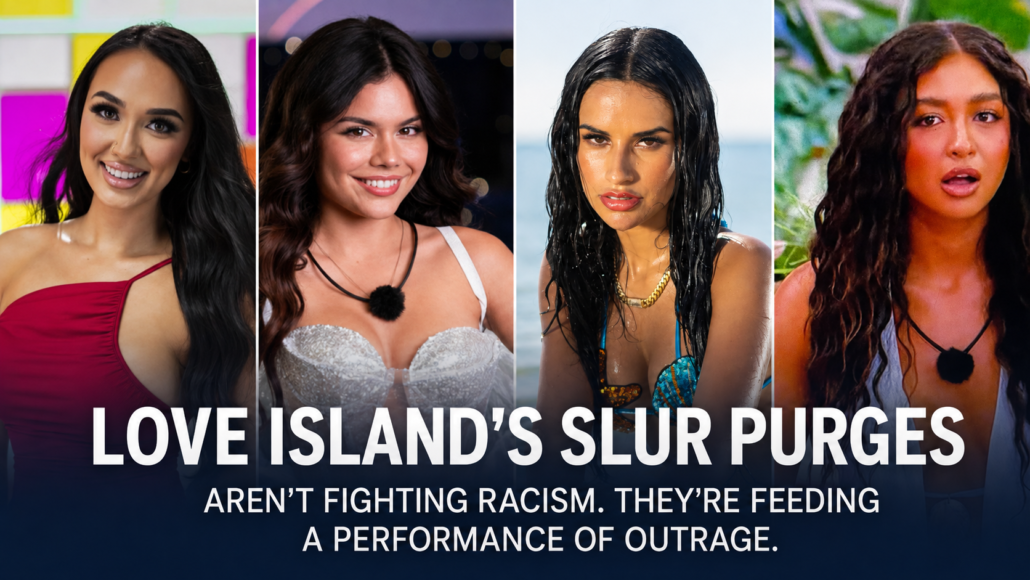
Love Island’s Slur Purges Aren’t Fighting Racism. They’re Feeding a Performance of Outrage.
At this point, getting removed from Love Island USA for something you said years before entering the villa has practically become another part of the show. There is Casa Amor. There is Movie Night. There is the public vote. And now, apparently, there is the moment when people comb through every podcast, Instagram Story and teenage video a contestant has ever posted, find an offensive word, circulate it without much context and demand that the person disappear.
Four women have now been removed from Love Island USA under remarkably similar circumstances: Yulissa Escobar and Cierra Ortega during Season 7, followed by Vasana Montgomery and Alannah Keyser during Season 8. None was accused of directing racial abuse at another Islander. None was removed because viewers had watched her discriminate against someone on or outside the show. Their offenses were found in recordings and social media posts—some dating back to their teenage years—in contexts that were objectively different from using a racial slur to demean or attack someone.
Let me say the obvious before someone deliberately misunderstands the argument: non-Black people should not use the N-word. Anti-Asian slurs—or any culturally insensitive or offensive language—should not be tolerated. We should discourage that language, explain its history and call people out when its use reveals actual prejudice or malicious intent. But surely there must be some intellectual space between “You should not have said that” and “You must immediately lose this opportunity and be erased from the show,” regardless of whether you have since grown up, educated yourself and come to understand why it was wrong.
Apparently, there is not. Alannah Keyser’s case may be the clearest example of how ridiculous this system has become. A six-year-old video resurfaced showing her singing along to Roddy Ricch’s “The Box” and failing to censor the N-word. She was reportedly around 15 at the time. Peacock removed her from Casa Amor, and the show announced her disappearance with almost no explanation. Keyser later apologized and said that the word was no longer part of her vocabulary.
What, precisely, are we accomplishing by expelling a 21-year-old from a dating show because she sang an offensive lyric at 15? Are we establishing that she is racist? If so, where is the evidence of racial animus? Are we protecting the Black contestants from her? If so, did anyone bother to determine how she had actually treated them? Or are we simply punishing her because a clip exists and because allowing her to remain would have subjected Peacock to several days of angry posts? There is accountability, and then there is sacrifice. This looked much more like the latter.
Vasana Montgomery was similarly removed from the Season 8 cast before the premiere after two videos from her teenage years surfaced. In one, she was rapping along to a song containing the N-word. In another, she reportedly used the word while playing a shooting game at an arcade. She later apologized, said there was no excuse and explained that she had grown considerably since the videos were made. According to the Los Angeles Times, both clips dated to her teen years.
Criticism for missteps is fair, but is not the same thing as concluding that someone is irredeemably racist. Teenagers absorb language from music, friends, social media and the cultures surrounding them. Sometimes they repeat words whose histories they do not fully understand. That is not an excuse. It is context, and context is what allows us to decide what an action actually tells us about the person who committed it.
Which brings me to Yulissa Escobar. Old podcast clips showed her using the N-word naturally in conversation while discussing relationships. She did not use it as a derogatory term. She was not insulting, expressing contempt for Black people or using the word to establish anyone’s racial inferiority. She spoke as though the word were simply part of her everyday vocabulary.
That does not necessarily reveal racism. It may reveal the cultural environment in which she learned to speak. I lived in the South Bronx for years, and I can tell you from experience that Black and Hispanic kids often grow up in the same neighborhoods, belong to the same friend groups, listen to the same music and use much of the same language. The N-word is frequently part of that shared vocabulary. Hispanic kids use it with their Black friends, and their Black friends use it with them. Within those relationships, it is often understood as familiar language rather than a racial attack. We can believe that non-Black people should not use the word while still acknowledging that this is how some people actually speak in certain communities.
Looking at Yulissa’s clips, her use of the word appeared to come from that kind of familiarity, not racial hostility. Perhaps she grew up in a similar environment and did not understand at the time that a word accepted within her immediate social circle would be judged very differently by the wider public. That does not mean she should never have been corrected. It means her behavior should have been evaluated for what it was, rather than automatically treated as evidence that she was racist.
And this is where Cardi B makes the inconsistency interesting. Cardi B has used the N-word naturally and publicly throughout her career without being erased from the entertainment industry. Yes, she identifies as Afro-Latina. But where, exactly, are we drawing the line? By ancestry? Skin color? Appearance? Neighborhood? Who someone grew up around? Whether the public perceives that person as Black enough?
If you asked many Black Americans how they identify Cardi B, they would probably describe her first as Hispanic or Latina, not as a Black woman. Most Latinos are racially mixed, and many have some degree of African ancestry. That fact alone cannot provide a clear and consistent rule about who is permitted to use the word. Nor am I arguing that every Hispanic person with African ancestry should be allowed to say it.
I am arguing that language exists within a context. Cardi B grew up in the Bronx, where Black and Hispanic cultures have lived beside each other, influenced each other and developed a great deal of shared language. That cultural reality is routinely used to explain why the N-word is part of her vocabulary. Why, then, is it inconceivable that the same reality might explain Yulissa’s? Why is Cardi allowed the complexity of identity, neighborhood and culture, while Yulissa is reduced to one word in a podcast clip?
Then there is Cierra Ortega. Two resurfaced posts, from 2020 and 2023, showed her using a derogatory term associated with Chinese and other East Asian people. In one, she used it while describing the appearance of her eyes after Botox; in the other, she used a variation of it to describe her own smile. She was removed from the villa late in Season 7, after she had become one of the show’s central contestants.
The term is offensive. Asian people who have had their features mocked with that language are completely justified in explaining why it hurts. But Cierra was not insulting an Asian person. She was not arguing that Asian people were inferior. She was describing her own eyes, however ignorantly, using a word she later said she did not know was a slur.
Does ignorance absolve her? No. But it does help us distinguish ignorance from hatred, and that distinction matters if the purpose is to assess whether someone is racist rather than simply prove that she once used prohibited language.
I hesitate to call what Love Island is doing accountability. What we have instead is social-media pressure followed by corporate risk management. It is a corporation protecting its brand while allowing viewers to experience the thrill of a public punishment.
And, of course, the punishment rarely ends with removal. Cierra said people contacted immigration authorities about her family. Her relatives received threats. Strangers attacked people associated with her. This is the part of online accountability that everyone pretends not to see. The network makes a swift, supposedly principled decision, but the decision also confirms to the mob that the contestant has been officially designated a bad person. Once that happens, almost any cruelty toward her becomes acceptable because it is being committed in the name of opposing racism.
Nothing says racial justice quite like trying to have a Latina woman’s family deported.
The people participating in these campaigns will say that intent does not erase impact, which is true. But impact does not erase intent either. The irony is that this kind of fake outrage may ultimately make it harder to confront real racism. If the same moral alarm is activated for a teenager singing a song and for someone deliberately humiliating a Black or Asian person, the alarm eventually loses its meaning. People begin to assume that every racism controversy is exaggerated. They stop listening. Actual discrimination gets folded into the same endless cycle of screenshots, hashtags, apologies and corporate removals.
Meanwhile, the more difficult questions remain untouched. How were contestants of different races treated inside the villa? Were some women consistently considered less desirable because of their skin tone? Did producers reproduce racial stereotypes through their edits? And what about the treatment of KC and Titi, who have since described the villa as hostile and said the narratives created around them contributed to the racist abuse they received outside the show? Love Islandseems very comfortable presenting itself as an authority on racism when removing contestants. It appears much less interested in examining the racial dynamics it may be helping to create.
Those questions are less emotionally satisfying because they may not produce an instant villain. They require us to tolerate ambiguity, and social media hates ambiguity. But racism is too serious to be reduced to a scavenger hunt for offensive words


Leave a Reply
Want to join the discussion?Feel free to contribute!